LifeLabs Takes Action Toward Truth and Reconciliation
At LifeLabs, we recognize that Indigenous communities within Canada have long faced systematic injustices, including inequitable access to healthcare, and we are committed to doing our part to address these harms.
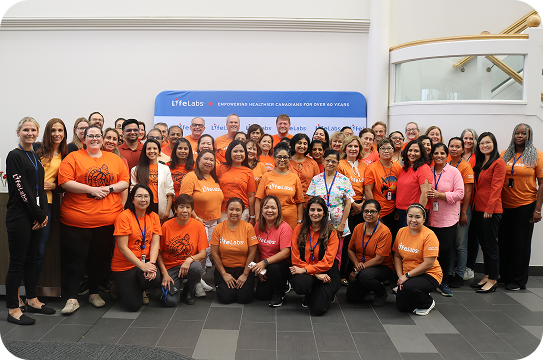
For the fourth consecutive year, we observed the National Day for Truth and Reconciliation, reaffirming our commitment to Indigenous communities across Canada. Reconciliation is an ongoing journey, not a single day, and we are proud to highlight how our team embodies this commitment within their work.
We work with rural and remote First Nations communities to develop innovative solutions for transportation and recruitment. Over the past three decades, our mobile and logistics teams have helped connect hundreds of remote communities, including 200 Indigenous communities, to essential health services. One of the most remote nursing stations we support is in Fort Severn First Nations in Ontario, 853 km north of Thunder Bay. LifeLabs receives samples from Fort Severn via a daily flight to Thunder Bay, where our dedicated team prepares them for testing at our labs in Thunder Bay and Toronto.
In British Columbia, LifeLabs is engaged in a multi-year collaboration with the Stellat’en First Nation and several other partners to develop drone programs for transporting test samples and medical supplies to remote Indigenous communities. “As a Native community, we’re at the forefront of this technology,” Chief Robert Michell of Stellat’en First Nation says.
Recognizing that cultural respect and sensitivity are central to equity, LifeLabs partners with Indigenous communities to provide services in ways that are culturally aligned. One such partnership is LifeLabs’ mobile clinic located within the Kal’numet Primary Care Clinic in West Vancouver and operated by Squamish First Nations. Our presence within the clinic allows LifeLabs to provide services in a trusted space that is culturally-aligned for Indigenous customers.
Employment equity is also essential, and LifeLabs has committed to improving education opportunities for Indigenous Canadians. Through a partnership with Indspire, a national Indigenous charity, LifeLabs provides $10,000 in annual bursaries to Inuit, First Nations and Metis people seeking post-secondary education in healthcare, science, and administration. Past winners have pursued careers as paramedics, x-ray, lab or radiation technicians, nurses, phlebotomists, kinesiologists, and researchers in health and biomedical sciences.
This bursary program helps talented individuals like Christina Tsuil-menak fulfill their dreams. Christina, a member of the St’uxwtéws (Bonaparte First Nation), part of the Shuswap Nation Tribal Council of the Secwépemc (Shuswap) people, won a bursary in 2024 to support her nursing studies. Her goal is to work in public health and challenge racism and inequity in the healthcare system. “I want to be a voice for those who can’t speak up. With my skills and knowledge, I hope to make a difference, even if it’s just with one person,” she says.
Team members like Christina, who generously share their experience and perspective, are making a difference within LifeLabs as we collectively strive for greater awareness, sensitivity, and equity.



 BACK TO HOME