

 BACK TO HOME
At the frontline, that means a deep commitment to compassionate and responsive care. And as an organization, it means constantly innovating to make diagnostics more personalized, accessible, and informative to empower Canadians’ health.
The following collection of stories highlights the many ways our passionate, creative, and talented teams shape every aspect of our services around our customers’ perspective.

Advancing Early Detection and Care for Canadians
As a trusted leader and healthcare partner, LifeLabs proactively develops solutions to address emerging health concerns, empowering customers across Canada with actionable insights.
In 2024, LifeLabs launched a new portfolio of tests designed to transform diagnosis and intervention, helping clinicians and customers better manage Alzheimer’s disease and other forms of dementia. These new blood tests are less invasive, less expensive and provide results more quickly than previously available tests. The tests also provide a more detailed and accurate diagnostic picture that includes the genetic risk factors for late-onset Alzheimer’s, a blood biomarker to confirm an Alzheimer’s diagnosis, and early indicators that the disease is present.
They’re also part of LifeLabs’ growing suite of Alzheimer’s and dementia support services. LifeLabs collaborates with organizations such as MINT Memory Clinics, a non-profit dedicated to improving Alzheimer’s care, to build healthcare providers’ awareness and adoption of these new diagnostic tools. With over 120 primary care sites across the country, MINT Memory Clinics will also adopt and integrate Alzheimer’s blood biomarker testing into their own diagnostic and assessment processes.
LifeLabs also contributes to making dementia care more effective and accessible through partnerships with organizations such as the Alzheimer’s Society of Ontario (ASO) to raise awareness about the disease and the importance of early intervention, testing, and access to appropriate treatments.
These innovations and partnerships are advancing effective Alzheimer’s and dementia treatment — helping Canadians and their families gain hope with a new understanding of these diseases, and how to navigate them.
Small Gestures, Big Impacts
Behind every test is a human being who deserves to be treated with compassion, patience, and kindness.
While every LifeLabs team member plays a role in making that happen, those who work on the frontline see and feel this reality in a personal way. And when a frontline team receives a heartfelt message from a customer, it’s a powerful affirmation of why customer-first care matters.
This was the case when a customer had lunch delivered to the team at an Ontario Patient Service Centre in appreciation for the warm, professional, and excellent care she had received. There was also the review that a Patient Service Centre in Burnaby received from a woman who brought her 90-year-old mother in for blood work. The mother, who has dementia, struggles with waiting rooms and blood tests. The staff at the Burnaby Patient Service Centre brought her in quickly and helped her ease her anxiety. The customer’s daughter wrote to express her gratitude for their kindness which “resulted in minimal distress to my mom.”
Often, customers who have difficulty with blood tests will come to develop deep trust with a particular phlebotomist and will ask for them by name. One little girl in Northern Ontario, who has a rare condition that requires frequent blood draws, was grateful to find LifeLabs technician Kristina Simms, who has a special knack for working with children. They developed a relationship that has persisted over several years and the child now calls Kristina her “hero.” The girl’s mother wrote to the Patient Service Centre to say that: “Kristina made my daughter laugh and feel special and not scared. We decided to never take her to anyone else again.” For Kristina and other frontline team members, these experiences are “proof that what we do means something.” As Kristina says, “Sometimes we can make a difference in [customers’] lives, but they can also make a difference in ours.”

Empowering Canadians with Leading-Edge Research
LifeLabs is recognized as a global leader in diagnostics, thanks to its multidisciplinary expertise, technology adoption, and sophisticated data analytics.
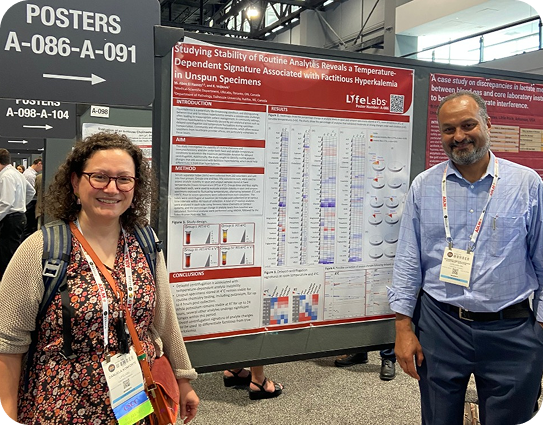
This leadership was on full display when several members of LifeLabs’ Chemistry Medical Scientific Team presented to academic, industry and clinical colleagues from around the world at the 2025 Association for Diagnostics and Laboratory Medicine (ADLM) Conference in Chicago. Our scientists are the forefront of innovative customer care at LifeLabs. At the same time, they advance diagnostic science through their contributions to professional associations and research publications, and through teaching appointments at Canada’s most distinguished academic institutions.
At the ADLM Conference, LifeLabs’ scientists showcased a variety of collaborative research projects. Clinical Biochemist Dr. Danijela Konforte, PhD, FCACB, and Laboratory Scientist Dr. Difei Sun, PhD, PMP, presented “Laboratory Process Tracker (LPT): a tool for real-time tracking of samples, instruments, and workflow steps used in clinical mass spectrometry testing.” Using barcodes, LPT monitors each sample, instrument, and step, quickly spotting errors so they can be fixed immediately. Since 2022, it has helped the lab efficiently manage hundreds of test batches monthly, saving time and ensuring accurate results for customers.
Innovation was also on display when Clinical Biochemist Dr. Kika Veljkovic presented: “Studying Stability of Routine Analytes Reveals a Temperature-Dependent Signature Associated with Factitious Hyperkalemia in Unspun Specimens.” This study found that Hyperkalemia, or high potassium, can be life-threatening; however, test results may sometimes show falsely high levels. As part of her work, Dr. Veljkovic, who also teaches at McMaster University, identified lab changes that reliably flag false high potassium, helping doctors make more accurate diagnoses and ensuring customers get the right care.
Essential research to improve processes was also on display when Clinical Biochemist Dr. Terence Agbor, BMLS, M.Sc., PhD, FCACB, presented: “Stability of urine in the BD Vacutainer® Plus Conical Urinalysis Preservative Tubes for Chemical and Microscopic Urinalysis.” Dr. Agbor, an active member of the Canadian Society of Clinical Chemists, found that urine samples for routine urinalysis stay accurate for up to 48 hours when stored in a particular brand of preservative tubes. Most test results — including glucose, protein, and cell counts — remained stable, making it easier to transport samples to centralized labs without affecting customer care. Only appearance and crystal type showed minor changes, confirming these tubes reliably preserve urine for safe and timely testing.
Moving beyond the lab and into education, Clinical Biochemist Dr. Meshach Asare-Werehene presented three studies resulting from the University of Toronto Clinical Biochemistry Fellowship, including: “Evaluating a Patient-Centered Education Initiative in Preventing Pre-analytical Errors and Improving Patient Satisfaction in Clinical Diagnostic Laboratories.” In this study, Dr. Asare-Werehene, who teaches at the University of Ottawa, showed that clear customer education can save lives — and lab results. He demonstrated that simple, easy-to-follow materials significantly increased understanding of biotin interference from 45 to 87 per cent, helping to prevent errors, improve care, and keep customers informed and empowered.
Through these and many other studies, our scientists create innovation and advance diagnostics in Canada while placing LifeLabs at the cutting edge of global diagnostic trends.
Not Just a Test: Point of Care Testing Transforms Long-Term Care
Since 2024, LifeLabs has been partnering with the Ministry of Long-Term Care to bring Point of Care Testing to long-term care homes in Ontario — directly where residents live.
Point of Care Testing (POCT) provides sample collection, test analysis, and fast results right on site to detect COVID-19, Flu and RSV, assess heart attacks and failures, and run basic metabolic and urinalysis panels.
Residents have samples taken immediately without having to wait for a mobile visit or travel to a healthcare provider. Results are available faster, so clinicians and staff can make timely decisions with confidence to treat customers. Where infectious diseases are concerned, this solution also supports customers’ social and emotional well-being. Results are obtained quickly and, if negative, customers do not have to spend unnecessary time isolated from loved ones and out of their normal routine.
The program began with a pilot involving more than 800 residents in six communities. The results of the pilot speak volumes. Point of Care Testing is empowering Canadians in long-term care homes with fewer emergency transfers, faster and more reliable results for healthcare providers, and earlier treatment, leading to better customer outcomes. Based on this success, the Ontario government has committed to expanding the program.
Point of Care Testing in long-term care shows what’s possible when LifeLabs teams, government and industry come together to find innovative solutions that empower healthier Canadians.

Improving Equity in the Treatment of Iron Deficiency
Medical science continually expands our understanding and treatment of disease.
At LifeLabs, we continuously search for opportunities to innovate testing methods, especially for health issues that can have a significant long-term impact on millions of Canadians.
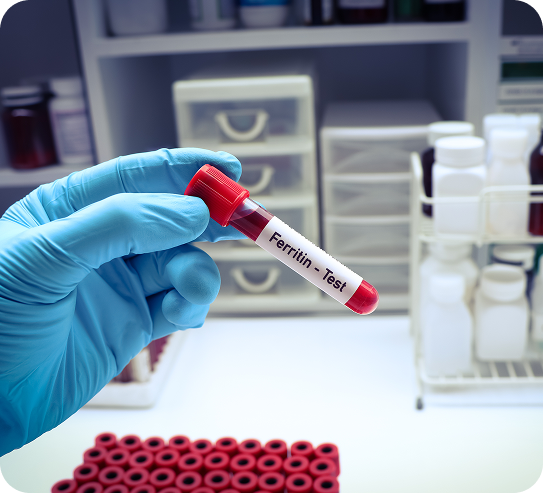
Recently, LifeLabs implemented new clinical decision limits for ferritin in line with leading-edge best practices. Ferritin screening is used to detect iron deficiency, which is the most common micronutrient deficiency and the number one cause of anemia worldwide. While debilitating, anemia is treatable and its impact can be minimized through early testing and treatment. The new guidelines allow for a diagnosis of iron deficiency to be made at a higher level of ferritin than previously. This is based on clinical observations worldwide which indicate that often women and children may suffer the clinical symptoms of iron deficiency even though their ferritin levels are high enough to fall within the previous guidelines.
“This change in ferritin testing is a game-changer for equitable care,” said Dr. Catherine Ross, Vice President of Medical and Quality Affairs at LifeLabs. “For women and children, it means symptoms won’t be overlooked, and treatment can start sooner, leading to a higher quality of life for millions.”
The guidelines also align with those suggested by the Ontario Medical Laboratory Association and the Raise the Bar campaign. LifeLabs partnered with Raise the Bar to raise awareness of the high prevalence of iron deficiency, particularly in women, and to improve the diagnosis and treatment of this correctable disorder.
Putting Diagnostic Power in the Hands of Canadians with At-Home Test Collection
LifeLabs’ at-home health test collection program is designed to meet customers’ needs for quick, accessible, and convenient support to proactively monitor common health concerns.
Self-collection kits allow customers to collect samples in the comfort and privacy of their own homes and send the samples to LifeLabs by mail, making these services easily accessible for customers in remote and rural areas. Results are available online to support discussions with healthcare providers about next steps.
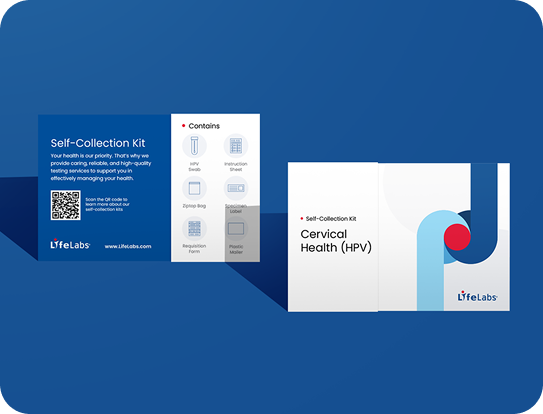
In 2025, LifeLabs continued to expand this program with the development and launch of new at-home collection kits for HPV, blood sugar, and Vitamin D testing. LifeLabs’ Vitamin D Health (25-Hydroxy) Kit allows customers to monitor Vitamin D levels quickly and conveniently, to check for a potential deficiency that can lead to bone disease and other issues. A simple finger prick is all it takes to capture a blood sample. The Diabetes Health (HbA1c) Kit supports customers in assessing their risk for type 2 diabetes, a common but preventable disease, and proactively take steps to reduce the risk through diet, exercise and other interventions as recommended by their healthcare provider.
Following the development of the Cervical Health (HPV) Kit in 2024, LifeLabs had the opportunity to partner with the Ontario Cervical Screening Program, a province-wide screening program for the HPV virus, which can cause cervical cancer. As part of an initial pilot, LifeLabs made the kits available to select healthcare providers, allowing customers to collect their sample privately in the healthcare setting. Following initial success and positive feedback from our partners, the program is now expected to expand to all healthcare providers covered under the Ontario Health Insurance Plan. As the program grows, we look forward to sending kits directly to customers at home.
Partnering with CAN Health Network to Bring More Personalized Care to Canadians
LifeLabs continually seeks out cutting edge technology to improve customer care, access, and convenience.
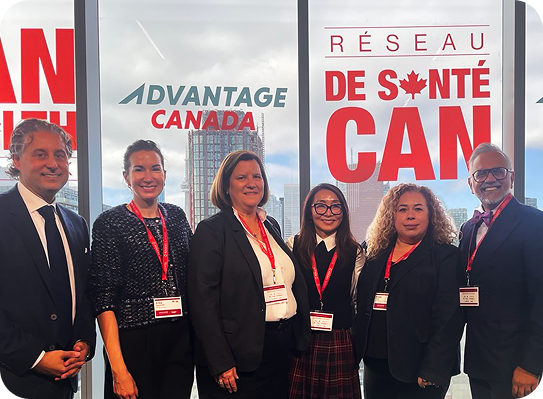
We operate Canada’s largest customer portal, providing over ten million Canadians with access to their test results. Now, an exciting new partnership with the Coordinated Accessible National (CAN) Health Network is poised to further sharpen LifeLabs’ technological edge. CAN Health Network brings together leading healthcare operators from across the country to identify their biggest challenges and match them with Canadian-made technology solutions. The network’s commitment to improving the health of Canadians makes it a perfect fit for LifeLabs.
“This is a powerful partnership that not only benefits customers but also supports the growth of Canadian tech companies and helps to strengthen our economy,” Charles Brown, LifeLabs President and CEO, says.
Thanks to the CAN Health Network’s community of high-tech innovators, LifeLabs has already begun integrating advanced technology into its operations to make testing even more efficient and provide more options for personalized care. LifeLabs continues to explore new technologies through this partnership and was a proud sponsor of the CAN Health Network conference in 2025, which brought together leading Canadian innovators in the healthcare space to explore the theme, “When we invest in our own, we don’t just compete; we lead!”
DISCOVER MORE About lifelabs